
Agricultural Solar Panel Cleaning That Protects Output
By Marquis Mason ·
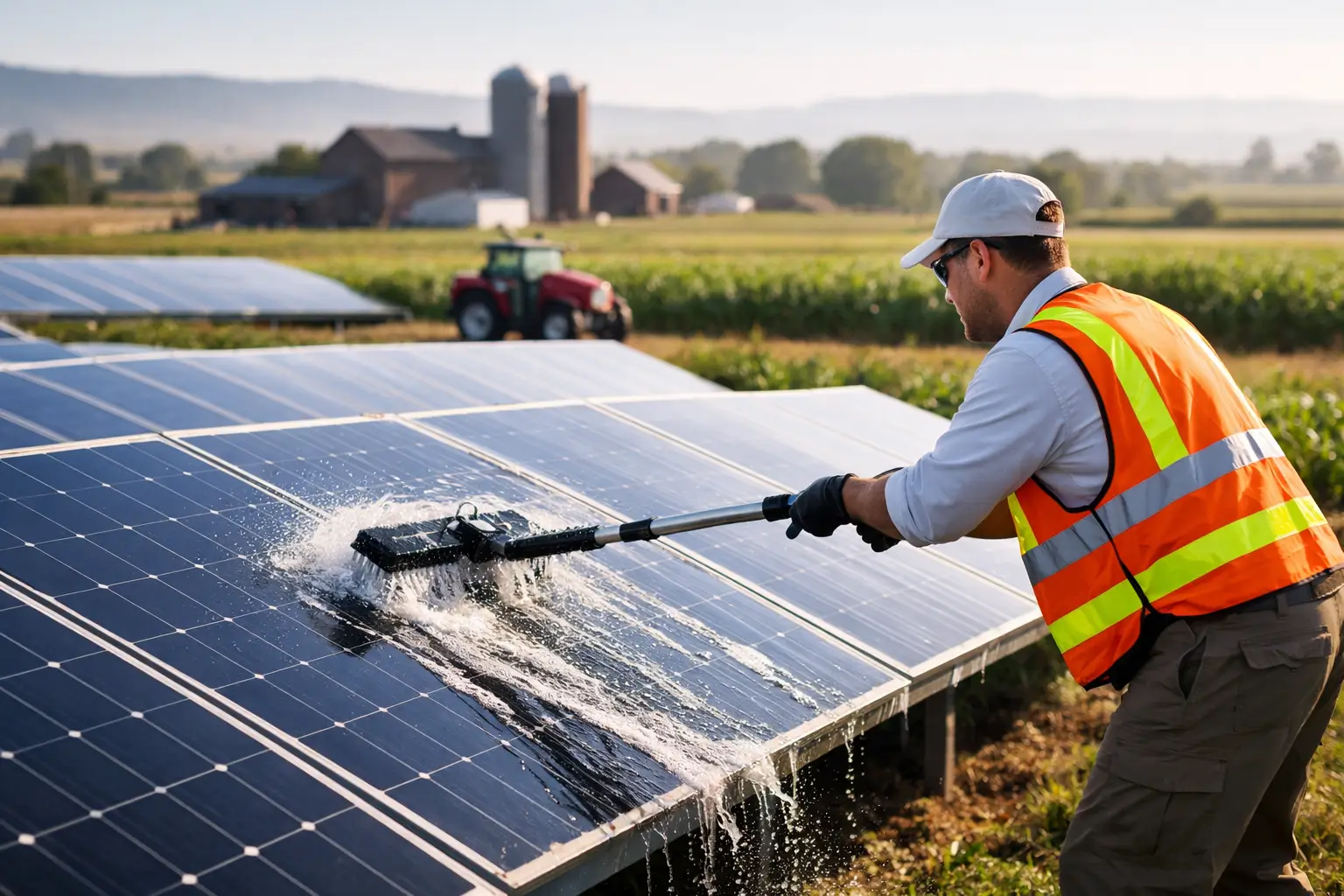
A farm solar array can look clean from the ground while losing meaningful production to a thin film of field dust, pollen, chaff, and dried mineral residue. Agricultural solar panel cleaning addresses that layer before it becomes an accepted, unmeasured cost of operating the system. For farms that depend on solar to offset refrigeration, ventilation, irrigation, grain handling, or general facility loads, production loss is not cosmetic. It affects the return on a major capital asset.
Why farm arrays soil differently
Agricultural sites create conditions that are harder on solar panels than a typical suburban rooftop. Tillage, gravel lanes, feed handling, harvest traffic, livestock operations, and nearby unpaved areas can put fine particulate matter into the air for long periods. Wisconsin pollen seasons can add a sticky coating that catches more dust, while bird droppings, leaves, and seed debris create concentrated obstructions that rain may not fully remove.
The problem is not simply that less light reaches the cells. Soiling is rarely uniform. One panel may be partially shaded by residue while adjacent panels remain relatively clear. That mismatch can reduce output across a string and, in more serious cases, contribute to localized heating known as hot spots. A hot spot is not a routine outcome of ordinary dust, but persistent, concentrated contamination is a condition worth correcting rather than ignoring.
Hard-water deposits create a separate concern. Spraying panels with untreated well water can leave minerals behind as the water dries. Those spots reduce light transmission and may be difficult to remove later. On an agricultural property, where well water is common and water access may be distant from the array, the convenient solution is often the wrong maintenance method.
What agricultural solar panel cleaning should accomplish
Effective cleaning should restore panel exposure without introducing a new risk. That means following the module manufacturer’s cleaning guidance, using soft equipment appropriate for photovoltaic glass, and avoiding harsh chemicals, abrasive pads, high-pressure washing, and untreated rinse water.
A professional process should also account for the realities of a working farm. It should not require the property owner to provide water or power hookups. It should be planned around livestock movement, delivery schedules, harvest activity, roof access, and site safety. For ground-mount systems, technicians need to watch for uneven terrain, drainage areas, fencing, and electrical equipment. For roof-mounted arrays, fall protection and OSHA-aware work practices matter as much as the cleaning method.
At Solar Alchemist, cleaning is performed with a custom mobile 100% deionized-water rig and soft rotary brushes. Deionized water is free of the dissolved minerals that cause spotting, so panels can dry to a spot-free finish without chemical residue. The objective is straightforward: remove the material blocking sunlight while treating the array as electrical equipment and a long-term asset, not as a surface that can be power-washed.
The production case is measurable, not assumed
Some farms will see a clear recovery after cleaning. Others may see a smaller change because their panels are steeply tilted, recently washed by sustained rain, or located away from dust-generating activity. The right question is not whether every array will produce the same percentage gain. It is whether the site has enough soiling-related loss to justify disciplined maintenance.
Production monitoring provides the best starting point. Look for output that trails comparable weather periods, a decline that cannot be explained by seasonal irradiance, or a persistent gap between expected and actual production. If monitoring is available at the inverter or array level, compare sections of the system. A visibly dirtier section or an area near a driveway, exhaust vent, grain operation, or bird perch may perform differently from the rest of the array.
Cleaning results should be evaluated under comparable conditions whenever possible. Same-day before-and-after readings can be useful, but cloud movement and changing irradiance can distort the comparison. Better evidence comes from inverter data, consistent weather windows, and documented site conditions. Solar Alchemist recorded a 16.7% production lift at the Wisconsin State Capitol and a 22% daily recovery for a Dane County homeowner under identical weather conditions. Those results are proof that soiling can matter substantially, not a promise that every farm will produce the same outcome.
A maintenance interval should follow site conditions
There is no responsible one-size-fits-all cleaning schedule for agricultural solar. A dairy operation beside active gravel traffic may need more attention than a barn roof surrounded by maintained grass. A low-tilt array holds debris differently than a steep roof array. A site with heavy spring pollen and fall harvest dust may benefit from seasonal service, while another may only need an annual inspection and cleaning.
A practical starting point is to inspect panels and production data after the conditions most likely to create buildup. On many Southern Wisconsin farms, that means checking after spring pollen, during or after dry field activity, and after harvest. If panel surfaces show a visible haze, droppings, or residue that remains after rain, cleaning should be considered before the loss compounds through the high-production months.
It also makes sense to clean before relying on the system’s output for a season of heavy electrical demand. A ventilation-intensive livestock building, for example, does not benefit from discovering mid-summer that its solar production has been quietly suppressed since spring.
Documentation protects more than energy production
For agricultural owners, cleaning records are part of responsible asset management. A basic service record should identify the date, array location, observed soiling conditions, cleaning method, and any visible concerns found during the work. Before-and-after photos can help demonstrate panel condition and show that maintenance was performed with an appropriate method.
That documentation can support internal maintenance planning, warranty conversations, property insurance claims, and lender or stakeholder reporting. It does not replace an electrician’s inspection or guarantee warranty coverage, but it creates a clear record that the owner addressed preventable contamination rather than allowing it to persist without review.
The record can also reveal patterns. If one roof plane repeatedly collects bird droppings or one ground-mount block consistently carries more dust, the owner can investigate the source. Sometimes the solution is more frequent cleaning. Sometimes it is changing a nearby traffic pattern, addressing a perch, or adjusting maintenance timing around farm activity.
What not to do with a dirty farm array
Avoid treating solar modules like siding, equipment, or barn windows. Pressure washers can force water where it does not belong and may conflict with manufacturer guidance. Household detergents can leave films that attract more dirt. Stiff brushes and abrasive tools can damage coated glass. Cleaning hot panels in direct sun can also create avoidable thermal stress and fast evaporation, particularly when untreated water is involved.
Waiting for rain is reasonable after a light dust event, but it is not a complete maintenance plan. Rain can move loose dirt while leaving bonded pollen, mineral spotting, oily residue, and droppings behind. A panel that appears better after rainfall may still carry the film that is limiting output.
The most useful approach is to combine visual inspection, production data, manufacturer-safe cleaning, and a written record of what was done. That gives farm owners a basis for deciding when service is warranted rather than cleaning on guesswork or postponing it indefinitely.
A solar array earns its keep one daylight hour at a time. Keeping the glass clear, the maintenance method appropriate, and the results documented is a practical way to protect the production your farm already paid for.