Does Rain Clean Solar Panels? Not Completely
By Marquis Mason ·
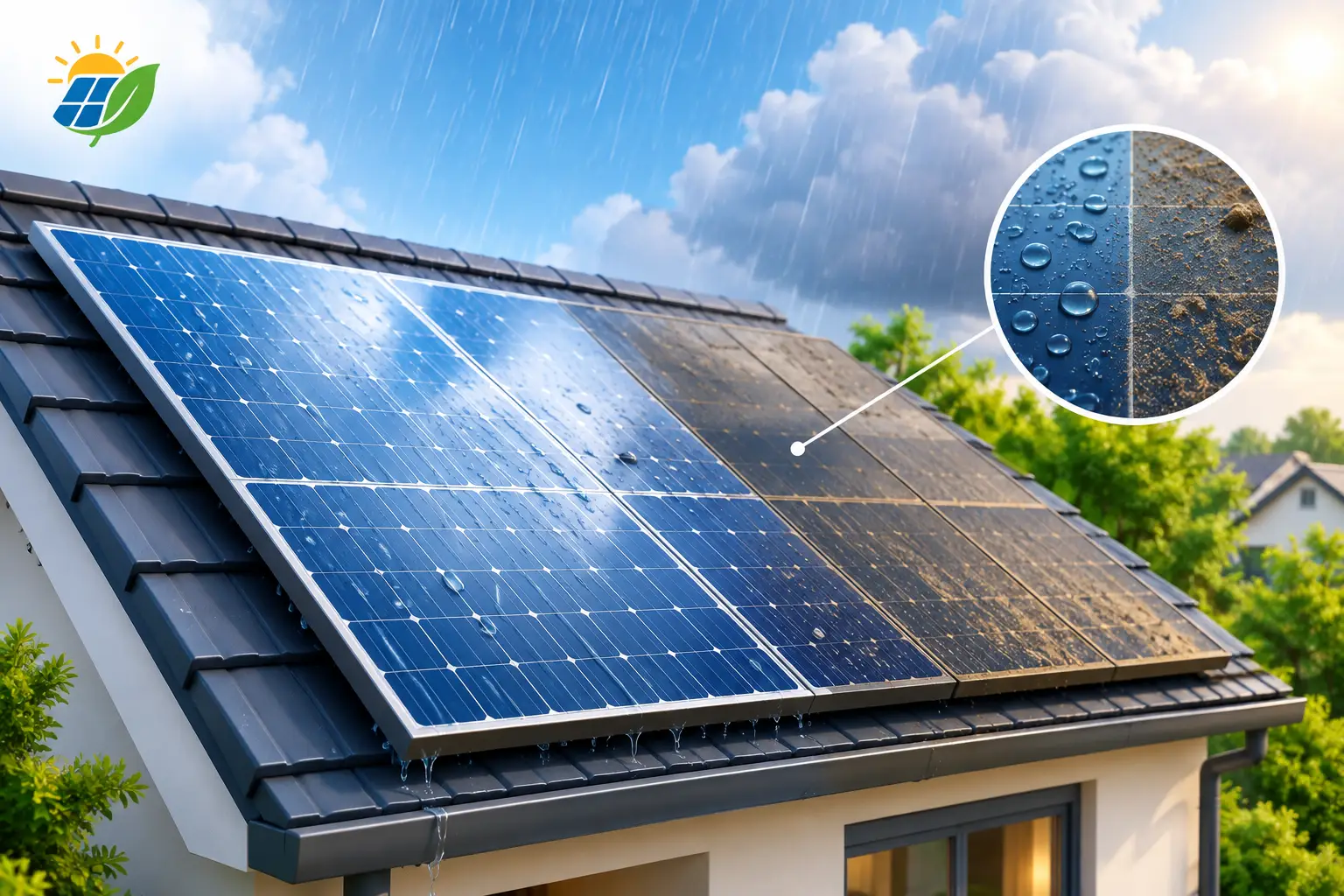
A steady Wisconsin rain can make a solar array look better from the ground. That does not mean it is producing like a clean array. Does rain clean solar panels? It can rinse away some loose, dry dust, but it is not a dependable cleaning method for the contaminants that most often reduce production.
Pollen, agricultural dust, bird droppings, pine debris, and airborne grime do not all behave the same way when wet. Some rinse away. Others bond to the glass, collect at frame edges, or turn into a thin film that still blocks light after the surface dries. For an owner watching output from a significant solar investment, appearance is a poor substitute for measured performance.
What rain can and cannot remove from solar panels
Rain is useful for loose surface dust when several conditions line up: the debris is fresh, the rainfall is substantial, the panels have enough tilt for runoff, and there are no sticky or mineral-based deposits underneath. A hard, sustained rain may improve conditions more than a light shower. But even a heavy rainfall is uneven across an array. The lower edge of a panel, corners near the frame, and areas behind debris can retain buildup.
Rain does not reliably remove bird droppings, tree sap, caked pollen, lichen-like biological residue, or oily roadway and agricultural film. Bird droppings are especially concerning because they create localized shade. A small opaque spot can force part of a panel to operate differently than the cells around it, increasing the risk of heat concentration known as a hot spot.
Rain also cannot correct mineral residue caused by sprinklers, roof runoff, or previous attempts to wash panels with hard water. When mineral-rich water dries on glass, it leaves deposits. Over time, those deposits can become difficult to remove safely and may contribute to staining or glass damage. Rainwater is generally softer than municipal well water, but rain falling through dirty air or washing grime down a roof is not a controlled, spot-free cleaning process.
Why rain can make panels look clean but still underperform
The problem is not simply dirt. It is how dirt changes the amount of sunlight reaching photovoltaic cells. A uniform haze of dust may cause a modest system-wide loss. Uneven soiling is often more disruptive because solar cells are electrically connected. Shading on one section can affect the behavior of cells around it.
After rain, the glass may look darker, clearer, and more reflective. From a driveway or parking lot, that can feel like proof that the array has been cleaned. Production data is the better test. Compare output under similar weather conditions, or review system monitoring for a recurring gap between expected and actual production. A sudden or persistent loss after accounting for season, cloud cover, and snow may point to soiling.
Solar Alchemist documented a 16.7% production lift after cleaning panels at the Wisconsin State Capitol. A Dane County homeowner recorded a 22% daily recovery under identical weather conditions. Those results should not be treated as a promise for every array. They do show why assumptions based on rainfall can leave recoverable production on the table.
Does rain clean solar panels after pollen season?
Pollen is one of the clearest examples of why the answer is usually no. In Southern Wisconsin, spring pollen can settle as a fine yellow-green coating, often mixed with dust, insects, and moisture. A light rain may dampen that layer and move part of it downhill. It may also leave a thin residue once the surface dries.
The same is true for farm dust and debris near fields, feed operations, gravel roads, or active work areas. Fine particles can settle into the small gaps around panel frames and collect where water flow slows. Arrays near mature pines or frequent bird activity need the same practical assessment. Rain is not a scheduled service with a known result. It is weather.
A professional cleaning removes the guesswork by using purified water and manufacturer-safe tools designed for photovoltaic glass. The goal is not to make the panels look polished from the ground. The goal is to remove light-blocking buildup without scratching coatings, leaving mineral spots, or creating a documentation gap for the asset owner.
When rainfall may be enough
There are situations where a dedicated cleaning is not immediately necessary. A newer array in an open area, with a good tilt and little bird activity, may shed ordinary dust reasonably well during a rainy period. If production data remains consistent with seasonal expectations and visual checks show no stuck-on material, monitoring is a sensible choice.
That assessment changes when there is visible residue, recurring production loss, nearby trees, agricultural exposure, bird droppings, or sprinkler overspray. It also changes for large commercial, farm, and public-sector arrays where small percentage losses can add up quickly across many panels.
The practical question is not whether rain ever helps. It does. The question is whether rain has removed the particular contaminants affecting your array, without leaving deposits behind. A visual check from the ground cannot answer that with confidence.
Why the cleaning method matters as much as the cleaning
A dirty panel should not be treated like a window or a driveway. Abrasive pads, harsh chemicals, pressure washing, and hard-water rinses can create problems that cost more than the lost production being addressed. High pressure can force water where it does not belong. Aggressive scrubbing can damage the glass surface or coatings. Tap water can dry into spots.
A controlled cleaning approach uses 100% deionized water and soft rotary brushes suited to photovoltaic panels. The deionized water lifts and carries away dirt, then dries without the mineral residue associated with ordinary water. It is a straightforward process, but the equipment, water quality, and technique matter.
For property owners, the other advantage is a documented record. Before-and-after photos, service details, and production observations help establish that soiling was addressed using a manufacturer-approved method. That record can be useful when warranty questions, insurance documentation, or facility reporting require more than a verbal assurance that someone sprayed the panels off.
Use production data to decide, not the forecast
The cleanest way to judge whether rain has done enough is to pair a visual inspection with production data. Look for trends rather than reacting to a single cloudy day. Compare similar weather windows when possible, and account for normal seasonal shifts in sun angle and daylight hours.
If your monitoring platform shows a steady decline that cannot be explained by weather, inspect the array for visible pollen film, streaking, droppings, or debris at the lower frame edges. For commercial and agricultural sites, a documented baseline before cleaning and a comparison afterward can turn the decision into a measurable operating choice rather than a cosmetic one.
Cleaning frequency depends on exposure, not a universal calendar. A tree-lined home with heavy bird activity may need attention on a different schedule than a wide-open rooftop. A farm array exposed to dust during dry periods may have a different pattern again. Rainfall is one factor in that decision, but it should not be the entire plan.
A cleaner array is a more defensible asset
Waiting for rain is understandable. It is free, familiar, and sometimes helpful. But it is not purified water, it does not brush away bonded contaminants, and it does not create proof of what was removed or how the work was performed.
If output matters, treat the panels as the energy-producing assets they are. Check what the data says after the next rain, then make the cleaning decision based on the condition of the glass and the production you can verify.