How to Clean Solar Panels Without Damaging Them
By Marquis Mason ·
A layer of pollen can look harmless from the ground. On a solar array, it can combine with dust, bird droppings, hard-water minerals, and farm debris to block light unevenly across the glass. Learning how to clean solar panels correctly is less about making them look polished and more about protecting energy production, panel surfaces, and the value of the system on your roof.
For Southern Wisconsin solar owners, the right method depends on what is on the panels, how accessible the array is, and what the panel manufacturer permits. Rain may rinse away loose dust, but it does not reliably remove baked-on residue, mineral film, or droppings. Those are the materials that deserve a deliberate response.
Start With Safety and the Manufacturer's Instructions
Before bringing out a hose or brush, read the cleaning language in the panel manufacturer's documentation. Most manufacturers allow gentle cleaning, but they commonly prohibit abrasive pads, harsh chemicals, pressure washing, and tools that could scratch the anti-reflective coating or damage seals. Warranty requirements vary, so the manual for your specific modules is the standard that matters.
Roof access is the other decision point. A panel is not worth a fall. If the array requires walking a steep roof, working near an edge, navigating fragile roofing, or reaching over obstructions, do not treat it as a weekend chore. Ground-mounted arrays and low-slope, safely accessible systems are different situations, but even those require care around wiring, conduit, and wet surfaces.
Cleaning should happen when panels are cool, usually early in the morning or later in the evening. Cold water on hot glass can create unnecessary thermal stress, and cleaning solution or rinse water will evaporate too quickly in direct midday sun. That fast evaporation is also how mineral spotting gets left behind.
How to Clean Solar Panels Safely
The basic approach is simple: loosen the soiling, lift it with a soft tool, and rinse without leaving residue. The details matter because solar glass is durable, but not invulnerable to scratching and mineral deposits.
Start by checking the array from the ground. Look for visible pollen film, dirt bands along the lower edge of modules, bird droppings, leaf debris, and white spotting. Note whether one section appears dirtier than the rest. Uneven soiling can produce uneven electrical output, which is more concerning than a uniform light layer of dust.
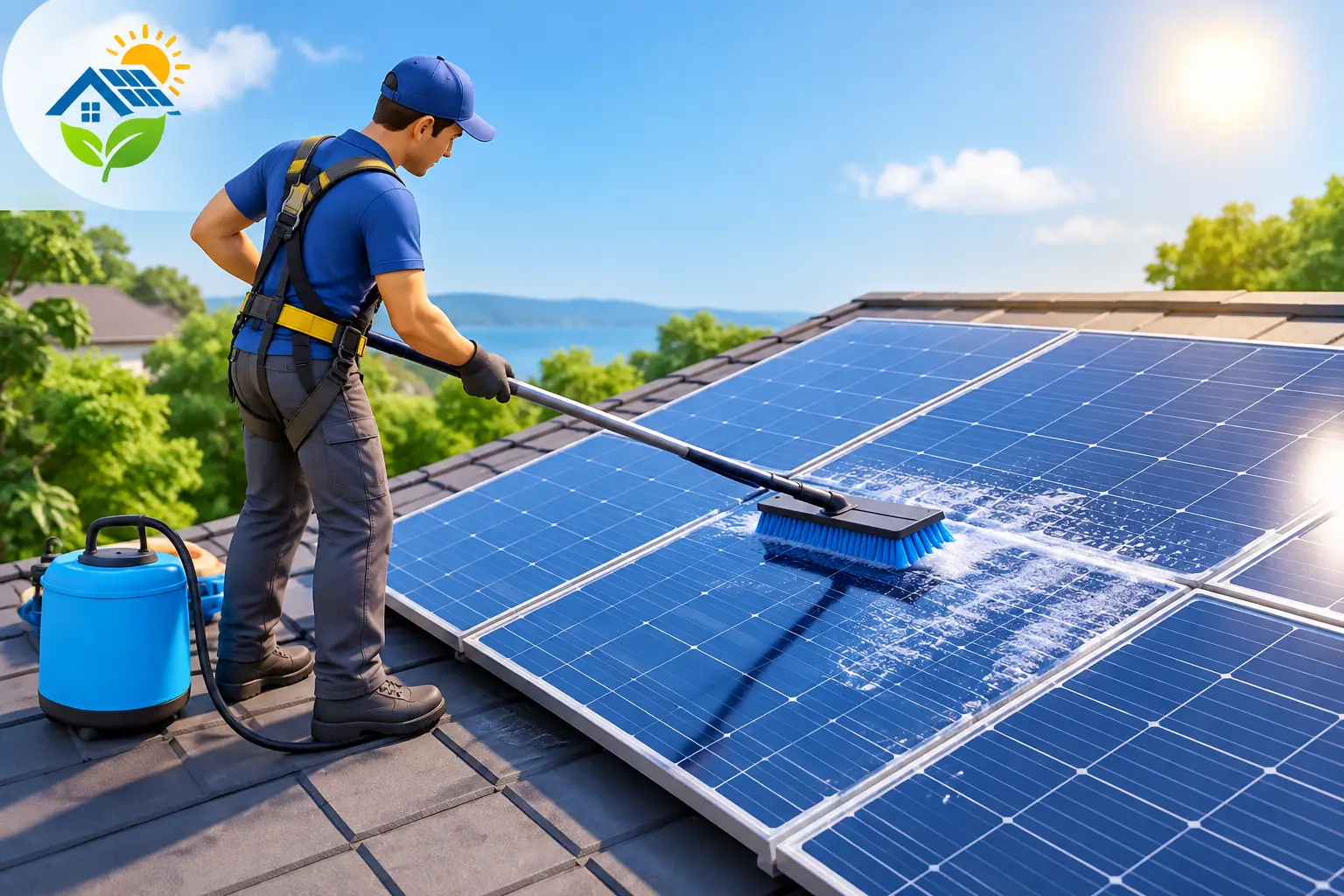
If the panels are safely reachable, rinse them gently with clean water. Do not use a pressure washer. High-pressure spray can force water where it does not belong, disturb seals, damage components, and create a risk around electrical equipment. A normal, low-pressure rinse is intended to soften and remove loose material, not blast the glass clean.
For material that remains, use a clean, soft-bristled brush or a purpose-built soft solar-panel brush. Keep the surface wet and use light, even passes. Never use scouring pads, steel wool, razor blades, stiff deck brushes, or powdered cleaners. A small scratch may be hard to see from the ground, but repeated abrasion can affect light transmission and create places for dirt to collect.
Then rinse thoroughly. If your local water is hard, as it often is in parts of Southern Wisconsin, a final rinse with untreated tap water can dry into mineral spots. Those deposits are not just cosmetic. Over time, mineral residue can bond to the glass and become more difficult to remove without increasing cleaning risk.
Professional cleaning crews address this with purified water. A 100% deionized-water rinse dries spot-free because the dissolved minerals have been removed first. It also eliminates the need for soap in most standard cleaning situations. Solar Alchemist uses deionized water and soft rotary brushes for that reason: the process is designed to remove soiling without leaving a new layer of residue behind.
What Not to Use on Solar Panels
A short list of avoided tools prevents most cleaning damage. Skip pressure washers, abrasive sponges, squeegees with worn or dirty blades, harsh degreasers, and household glass cleaners. Many glass cleaners are formulated for windows, not photovoltaic modules, and can leave films or contain chemicals that manufacturers do not approve.
Avoid cleaning products unless the manufacturer specifically calls for one and you can fully rinse it away. Plain purified water is usually the safer choice. Bird droppings can be stubborn, but the answer is time and gentle agitation, not stronger chemicals or more force.
Do not stand, kneel, or place ladders against the panels. Modules are engineered to handle weather loads, not concentrated point loads from a person or ladder foot. Even if no crack appears immediately, unnecessary mechanical stress is not a good trade for a cleaner surface.
When Cleaning Is Worth It
Not every dusty-looking panel needs immediate cleaning. The practical question is whether soiling is reducing output enough to justify the work and access risk. A light, even layer of seasonal dust may have a modest effect. Bird droppings, agricultural dust, tree pollen, and hard-water spotting can have a larger impact, especially when they collect repeatedly in the same areas.
Production monitoring gives owners a useful baseline. Compare daily or weekly production against similar weather periods, not a single cloudy day against a sunny one. Watch for a gradual gap between expected and actual output, especially during clear stretches when your system should be performing consistently. Visual inspection and production data together provide a better answer than either one alone.
Documented results can be meaningful. Solar Alchemist recorded a 16.7% production lift after cleaning panels at the Wisconsin State Capitol. A Dane County homeowner saw a 22% daily recovery under identical weather conditions. Those results are not a promise that every array will recover the same percentage. Soiling level, panel angle, local conditions, weather, and the age of the buildup all affect the outcome. They do show why cleaning should be evaluated as an energy-production issue, not a cosmetic service.
Set a Cleaning Schedule Based on Your Site
A fixed annual schedule works for some properties, but site conditions should lead the decision. An array near pine trees may need attention after heavy pollen periods. Farm systems can collect fine dust and organic residue during active field work. Commercial roofs near roads, construction activity, or exhaust sources can develop a different kind of film. Bird activity alone can change the cleaning need from one season to the next.
For many owners, an inspection after spring pollen and another before peak late-summer production is a sensible starting point. Systems with heavier exposure may warrant more frequent cleaning. The best schedule is one supported by photos, production readings, and cleaning records rather than guesswork.
Those records have value beyond tracking kilowatt-hours. Dated photos, documented conditions, and a clear description of the cleaning method help demonstrate responsible care if warranty questions, damage reviews, or insurance claims arise. For organizations managing multiple sites, consistent records also make it easier to compare performance and budget future work.
Know When to Call a Professional
Professional service is the practical choice when roof access is difficult, the array is large, mineral deposits are visible, or the owner needs formal documentation. It is also useful when you want a before-and-after production comparison without introducing DIY variables such as hard-water spotting or incompatible cleaning products.
Ask how the provider handles water quality, roof safety, insurance, and manufacturer restrictions. A credible cleaner should be able to explain the equipment used, avoid pressure washing and harsh chemicals, and document the work performed. For commercial, agricultural, and public-sector arrays, confirm that the provider can meet site requirements for insurance and work practices before scheduling.
A clean panel is not automatically a high-performing panel, but it removes one preventable obstacle between sunlight and production. Check the surface, compare the output, and use the gentlest method the conditions allow. That is how cleaning becomes disciplined solar asset care rather than another risky task on the roof.