
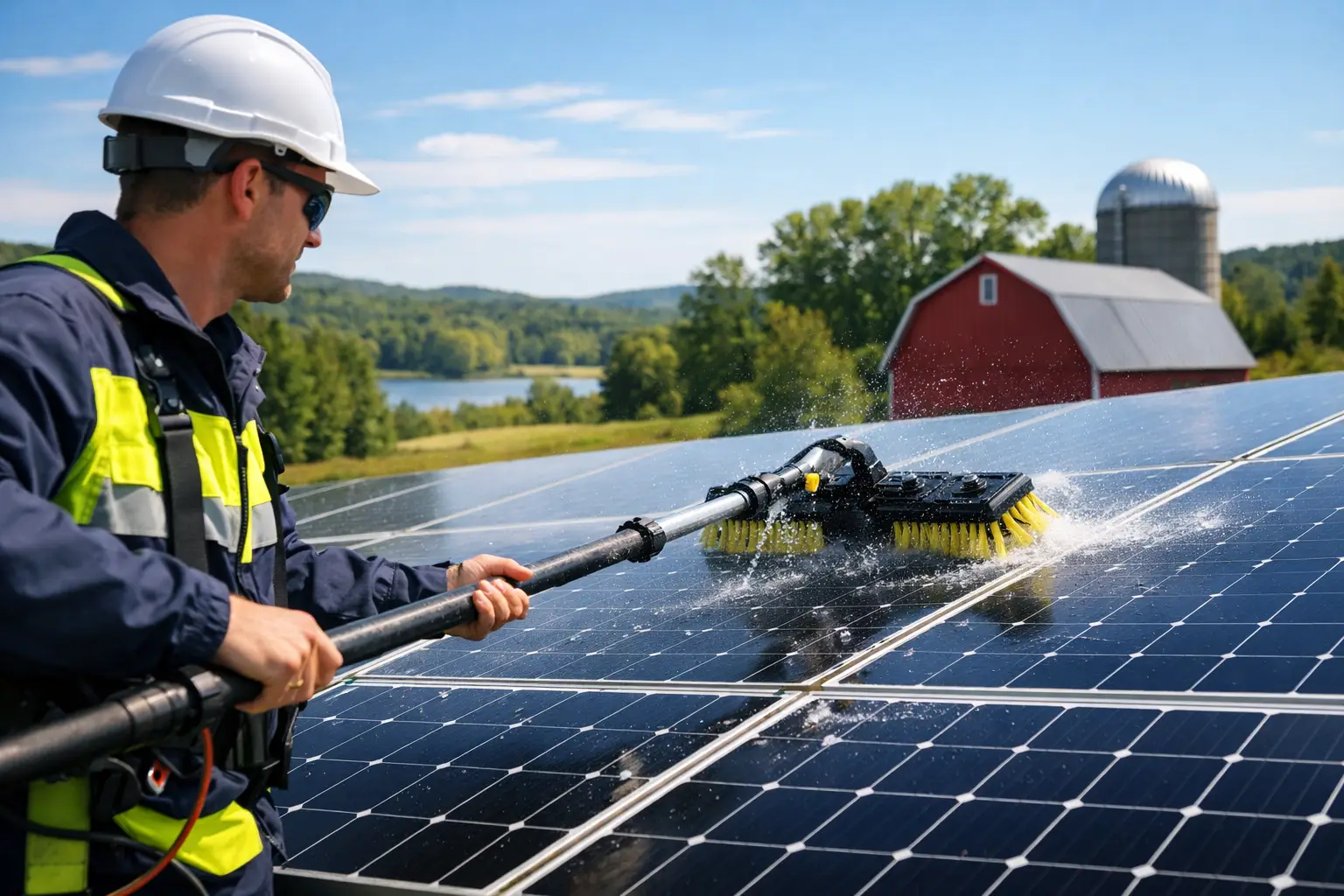
A solar array can look clean from the ground and still be losing production. In Southern Wisconsin, pollen films, field dust, bird droppings, pine debris, and mineral residue can block light unevenly across the glass. Manufacturer approved solar cleaning is not a cosmetic wash. It is a controlled maintenance method designed to remove that contamination without trading a production problem for scratched glass, chemical residue, or avoidable warranty questions.
For an owner who invested $20,000 or more in solar, the standard should be simple: clean the panels in a way the equipment manufacturer would recognize as responsible care, then document what was done. That means following the panel maker's published cleaning guidance, using appropriate tools and water, and avoiding shortcuts that can damage the module surface or its surrounding components.
What manufacturer-approved actually means
There is no single universal certification that makes every solar cleaning company "manufacturer approved" by every panel brand. Panel manufacturers publish their own operation and maintenance requirements, and those requirements differ by model, coating, mounting environment, and warranty language.
In practical terms, manufacturer-approved solar cleaning means using methods consistent with those written instructions. Most major module manufacturers prohibit abrasive pads, harsh chemicals, high-pressure washing at close range, and tools that can scratch anti-reflective glass coatings. They commonly call for clean water, soft non-abrasive equipment, and care around frames, junction boxes, wiring, and seals.
That distinction matters. A quick rinse with a garden hose may leave hard-water minerals behind. A pressure washer may force water into areas it should not reach. A stiff brush can create fine scratches that hold dirt and reduce light transmission over time. The right cleaning method is less dramatic, but it is far more defensible.
Why pure water is the safer choice
Southern Wisconsin water can carry minerals that dry into spots and deposits on panel glass. Those deposits are not just unattractive. They can scatter sunlight, attract additional grime, and become increasingly difficult to remove if left through repeated wet-dry cycles.
A 100% deionized-water system removes the dissolved minerals that cause spotting. The water dries clear, without soap, detergent, or rinse residue. When paired with soft rotary brushes designed for solar glass, it lifts bonded pollen, dust, and debris while keeping abrasion risk low.
Chemicals are not automatically necessary because a panel is dirty. In fact, adding cleaners without a clear manufacturer allowance creates unnecessary uncertainty. Certain products can leave a film that reduces light transmission, react with coatings, or complicate a warranty discussion later. A chemical-free process is not a marketing flourish. It is a practical way to clean the glass while keeping the service aligned with conservative module-care guidance.
Soiling is a production issue, not a housekeeping issue
Solar modules generate electricity when light reaches their cells. Soiling reduces that light, but the loss is not always uniform. A thin layer of pollen across an array may reduce production gradually. A concentrated bird dropping, leaf stain, or strip of heavy dust can shade a small section of a module much more severely.
Because cells within a module are electrically connected, uneven shading can create a weak point. Under the wrong conditions, that weak point may run hotter than surrounding cells. These soiling-related hot spots are not guaranteed to occur on every dirty panel, but they are a recognized risk where shading is persistent and localized. Cleaning cannot correct a pre-existing electrical defect, but removing the shading source is part of responsible prevention.
The production case is equally straightforward. Solar Alchemist documented a 16.7% production lift after cleaning panels at the Wisconsin State Capitol. A Dane County homeowner saw a 22% daily recovery under identical weather conditions. Those results should not be treated as a promise for every array. Roof pitch, system age, recent rainfall, site conditions, and the type of contamination all affect the outcome. They do show why measured before-and-after production data is more useful than guessing whether panels are "probably fine."
When cleaning makes financial sense
The best timing depends on the site. A rural array near crop fields may collect fine dust during planting and harvest. A home surrounded by pines may see a heavier spring pollen load and seasonal needle debris. Commercial roofs can collect airborne dust, soot, and bird activity that is easy to miss until output data shows a decline.
Owners should start with evidence. Compare current production against prior periods with similar weather and daylight, accounting for system expansion, outages, and known equipment issues. Inspect accessible modules for visible residue, especially along lower edges and around bird activity. If monitoring shows a persistent unexplained shortfall, cleaning is a sensible maintenance variable to investigate before assuming there is an inverter or panel failure.
Annual cleaning works for some properties. Others benefit from service after a high-pollen season, agricultural dust events, or an extended period without meaningful rain. Rain can rinse loose dust, but it does not reliably remove stuck pollen, bird droppings, mineral deposits, or oily residue. It also cannot provide a service record.
Documentation protects more than appearance
A manufacturer-approved approach includes the paperwork. If a module, roof, or electrical issue leads to an insurance claim or warranty inquiry, an owner benefits from being able to show that the array was maintained using a reasonable, non-damaging method.
A useful cleaning record identifies the service date, property, scope of work, cleaning method, and any visible concerns observed during service. Before-and-after photos add context. Production readings, when available, help connect cleaning to actual system performance instead of relying on appearance alone.
Documentation does not guarantee a warranty claim will be approved. Manufacturers and insurers make their own determinations based on their terms and the cause of loss. But a documented maintenance history is stronger than an unsupported statement that the system was cared for. For commercial, agricultural, government, and multi-site owners, that record also supports internal asset-management requirements and vendor accountability.
The method matters as much as the result
A proper cleaning visit begins with site-specific judgment. The technician needs to consider roof access, module condition, fall protection requirements, electrical hazards, and weather. Cleaning in extreme heat can create thermal-stress concerns, while icy conditions introduce obvious safety risks. The goal is not to put water on glass as fast as possible. The goal is to leave the array clean without creating a new problem.
The equipment should match that standard: purified water, soft brushes, controlled water flow, and careful handling around frames and electrical components. No abrasive scrubbers. No harsh chemical cocktails. No close-range pressure washing. No walking on modules.
For high-value solar assets, hiring an insured, OSHA-trained professional also changes the risk equation. Roof work carries real exposure for owners, employees, and tenants. A qualified provider should be prepared to supply formal documentation when required, including proof of insurance and business paperwork for larger accounts.
A practical standard for Southern Wisconsin owners
Ask a cleaning provider what water they use, whether they rely on chemicals, how they protect the glass and frames, and what documentation they provide after the work is complete. If the answer is vague, the method is probably vague too.
Solar Alchemist uses a custom mobile deionized-water rig and soft rotary brushes, so customers do not need to provide a water hookup or power. Every service is performed directly by founder Marquis Mason, with no subcontractor handoff. That owner-led model provides one accountable point of contact from quote through documented completion.
Your solar array is a working asset, not a decorative roof feature. Treat cleaning as measured preventive maintenance: use a manufacturer-aligned method, keep the record, and let the production data tell you whether the work paid off.