
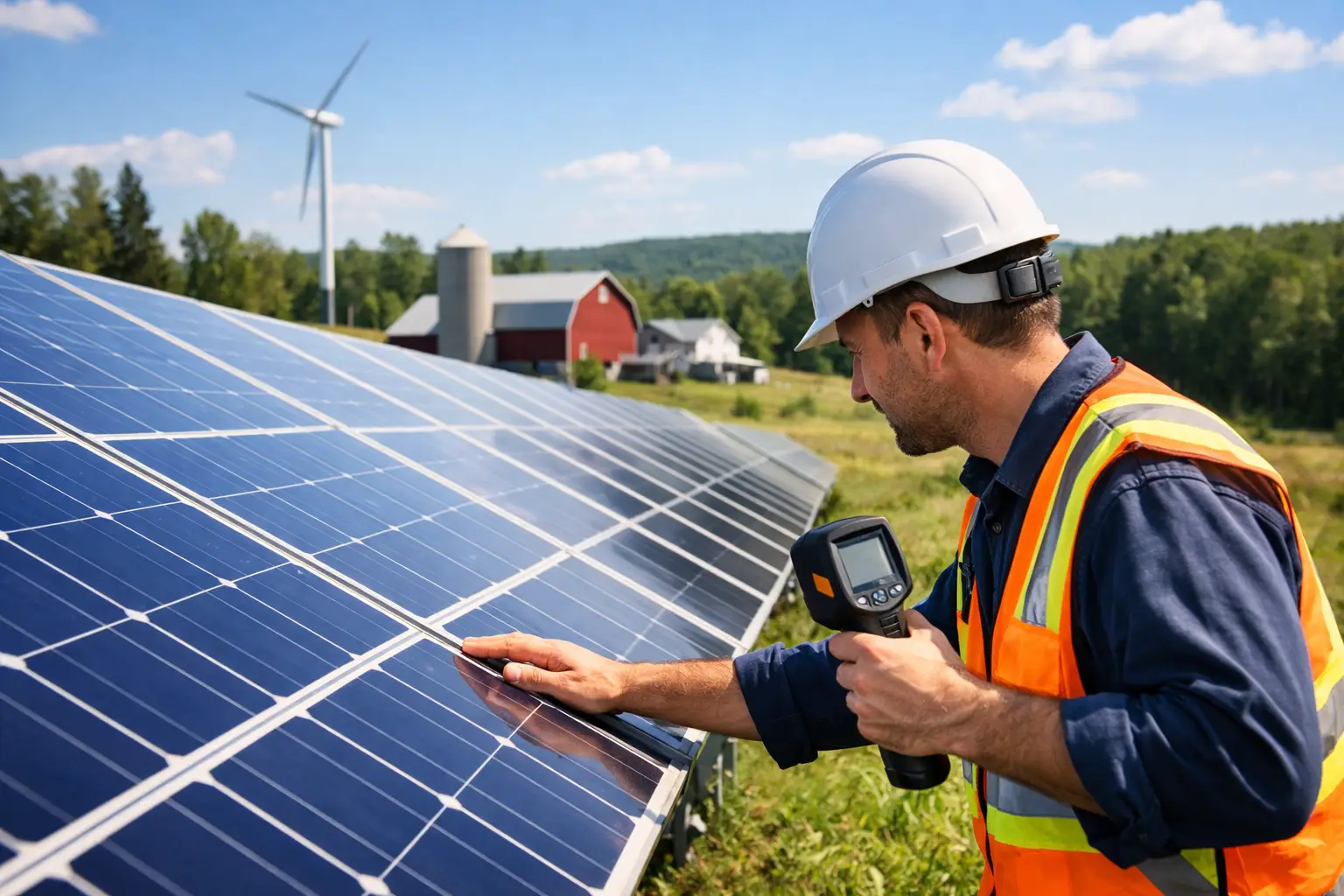
A solar array can look clean from the driveway and still lose meaningful production. In Southern Wisconsin, solar maintenance has to account for more than a thin layer of dust: spring pollen, agricultural residue, pine debris, bird droppings, and hard-water minerals can block light unevenly across a panel. That is not a cosmetic concern. It is an operating condition that affects the return on a major property investment.
For homeowners, the first sign may be a production graph that no longer matches similar weather from the prior year. For farms, commercial properties, and public facilities, the issue can remain hidden until lower output becomes a budget question. A disciplined maintenance plan gives owners a way to identify preventable losses, protect panel surfaces, and keep a record of what was done and when.
What Solar Maintenance Actually Covers
Solar maintenance is not a single task. It is the practical work of keeping a photovoltaic system safe, productive, and documented over its service life. Cleaning is often the most visible part, but it should be considered alongside visual condition checks, production monitoring, drainage awareness, and records that support manufacturer warranty requirements or insurance claims.
The scope depends on the system and site. A south-facing residential roof near mature trees faces different risks than a farm array beside gravel drives and cultivated fields. A commercial rooftop may collect airborne dust from HVAC activity, while a ground-mounted system can receive mud splash and vegetation debris. The right interval is based on what lands on the panels, how quickly it accumulates, and whether the system's production data shows a pattern that weather alone does not explain.
Most panel manufacturers allow cleaning, but they also set limits. Abrasive pads, harsh chemicals, high-pressure washing, and work performed on hot glass can create unnecessary risk. Manufacturer-approved care generally means soft equipment, appropriate water quality, and a method that does not scratch coatings, force water into electrical components, or leave residue behind.
Why Soiling Costs More Than a Dirty Appearance
Every solar cell needs sunlight to produce electricity. When soiling shades portions of a panel, the affected cells can limit the output of the electrical path they share. Light, even dust can reduce production gradually. Heavier deposits such as bird droppings, stuck-on pollen, or leaf fragments create more concentrated shade and deserve faster attention.
That uneven shading also raises the concern of hot spots. A heavily obstructed cell may operate differently from surrounding cells, creating localized heat. Modern panels include bypass diodes to reduce the effect of partial shading, but those protections do not turn persistent soiling into a maintenance-free condition. Regular observation and appropriate cleaning reduce a preventable source of stress.
Mineral deposits are another local concern. Wisconsin water can be hard. If panels are rinsed with untreated water and allowed to dry, minerals may remain on the glass as spots or haze. Those deposits can continue to interfere with light transmission, and repeated improper washing can turn a cleaning attempt into another source of loss. Deionized water dries spot-free because the dissolved mineral content has been removed.
The financial impact varies. A system with a light, uniform dust film may have a modest loss that does not justify frequent service. A system below pine trees, near agricultural activity, or under regular bird traffic may recover production much more quickly after cleaning. National Renewable Energy Laboratory research recognizes soiling as a variable performance loss, which is why site conditions matter more than generic promises about a fixed percentage gain.
Measured results make the decision clearer. Under comparable weather conditions, Solar Alchemist documented a 16.7% production lift at the Wisconsin State Capitol and a 22% daily recovery for a Dane County homeowner. Those results are evidence of what was present at those specific sites, not a guarantee for every system. The useful question is whether your array has similar exposure and a measurable gap between expected and actual output.
When Does a Solar Array Need Attention?
Production monitoring is the best starting point. Compare output with similar clear days, similar seasons, and similar system conditions. One cloudy week does not point to a cleaning need. A repeated decline during otherwise favorable weather deserves a closer look.
Physical evidence matters, too. Owners should pay attention when they see these conditions:
- Yellow pollen coating glass during spring production months.
- Bird droppings or clustered debris that create concentrated shade.
- Dusty film, crop residue, or mud splash after dry or windy periods.
- White spotting or streaking left by sprinkler overspray or prior rinsing.
Do not rely on a ground-level glance alone. A roof may have a different exposure than the rest of the property, and deposits can collect more heavily along lower panel edges or near roof features. At the same time, there is no reason to schedule service simply because panels are not visually perfect. Maintenance should be tied to the conditions that affect output, surface condition, or documentation requirements.
A Safe Cleaning Method Matters
The wrong cleaning method can undermine the reason for cleaning in the first place. Household glass cleaners may leave films. Stiff brushes and abrasive tools can damage glass coatings. Pressure washers can introduce force where it does not belong around seals, frames, wiring, or rooftop equipment. Municipal water can leave mineral residue as it dries.
Professional cleaning should use purified water and soft, panel-safe brushes designed to lift contamination without grinding it into the glass. Cleaning at an appropriate panel temperature also matters. Cold water on hot glass creates an avoidable thermal stress concern, particularly during bright summer conditions.
Solar Alchemist uses a mobile 100% deionized-water rig and soft rotary brushes to provide a chemical-free, spot-free finish. The method does not require a customer water connection or power hookup, which is useful for rooftops, farms, and facilities where access is limited. Just as important, the work is performed by founder Marquis Mason, not a rotating subcontractor crew. That provides a single point of accountability for the condition of the array and the service record.
Documentation Is Part of Asset Protection
A cleaning record is useful even when a warranty never becomes an issue. It establishes that the owner has treated the array as an operating asset rather than an unattended roof accessory. For commercial, agricultural, government, and multi-site owners, that record can support internal maintenance programs, property management reporting, and conversations with insurers.
Good documentation identifies the service date, the panel condition observed, the cleaning method used, and any visible concerns that should be reviewed by a qualified solar or electrical professional. Cleaning crews should not diagnose electrical faults beyond their scope, but a careful visual process can help flag obvious changes such as damaged glass, loose-looking components, unusual staining, or persistent debris sources.
For organizations, vendor qualification matters as much as the cleaning result. Insured operations, OSHA-aware practices, clear scopes of work, certificates of insurance, W-9 availability, and predictable invoicing reduce friction for facilities teams and procurement staff. A fast written bid should describe what will be cleaned, how access will be handled, and what documentation will follow.
Building a Practical Maintenance Schedule
There is no universal cleaning calendar for Wisconsin solar owners. Some residential systems may benefit from annual service after pollen season or before peak summer production. Others may need attention twice a year because of nearby trees, birds, field dust, or sprinkler overspray. Commercial and agricultural arrays often benefit from a scheduled review paired with production monitoring, especially where soiling exposure is predictable.
Start with a baseline. Record current production, inspect the visible condition of the array, and clean it using a manufacturer-safe method. Then compare output over equivalent weather periods after service. This creates a site-specific record instead of relying on assumptions. If the recovery is small, a less frequent schedule may make sense. If cleaning repeatedly restores meaningful production, the maintenance interval has a clear business case.
Roof access is another trade-off. A homeowner should not climb onto a steep or high roof to chase a possible cleaning gain. The cost of a fall, damaged panel, or compromised roof surface is far greater than a few lost kilowatt-hours. The same principle applies to facility teams using untrained staff for rooftop work. Solar maintenance should improve asset performance without creating a safety problem.
Your solar system was purchased to produce for decades, not just during its first clean season. Treat production changes as useful information, keep a clear maintenance record, and address the conditions actually present on your property. That approach gives you proof to work from before a small layer of soiling becomes a larger performance question.