
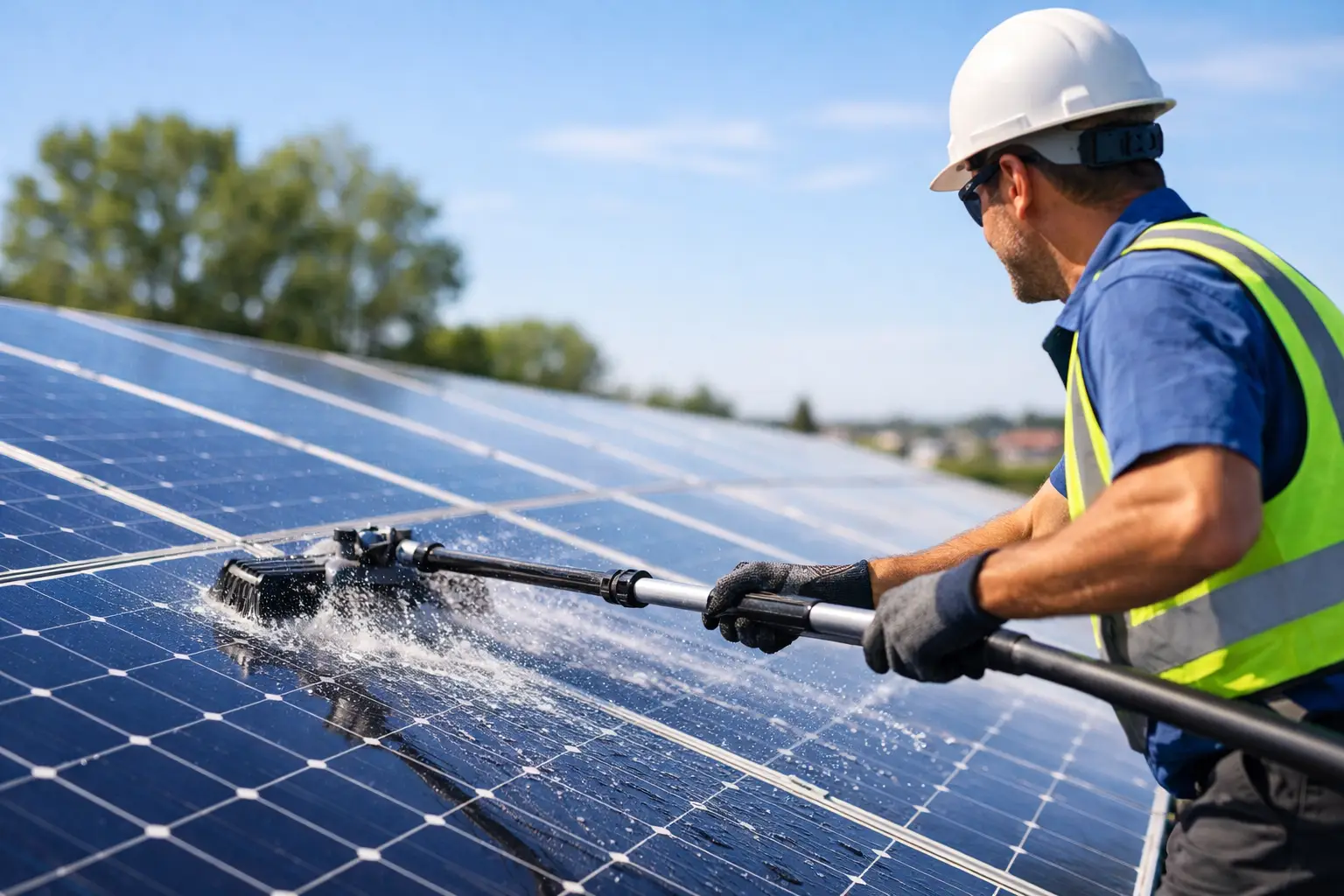
A solar array can look clean from the driveway and still be losing production. In Madison, pollen settles into spring moisture, road dust builds through dry stretches, and bird droppings or leaf debris can create concentrated shading on individual cells. Professional solar panel cleaning Madison WI service is not about making glass look better. It is about restoring available sunlight to the modules and documenting responsible care of a valuable energy asset.
For a homeowner watching monthly production in an app, a few percentage points matter. For a farm, commercial roof, municipal facility, or multi-site portfolio, small losses multiplied across hundreds or thousands of panels can become a measurable operating cost. The right cleaning decision starts with understanding what is on the glass, what it is doing to output, and how to remove it without introducing damage.
Why Madison solar panels get dirty
Southern Wisconsin has a practical mix of soiling conditions. Tree pollen and seed material are common in spring. Summer brings construction dust, agricultural dust, insects, and bird activity. In fall, pine needles, leaves, and organic debris can lodge along lower panel edges or around mounting hardware. Winter is different: snow cover is usually the main production limiter, but residue left behind after melt cycles can still affect exposed glass.
Not every layer of dust causes the same loss. A light, even coating may suppress production modestly across an array. A bird dropping, wet leaf stain, or clump of debris can block part of a cell group much more severely. That localized shading changes the electrical behavior inside the module. Bypass diodes help protect cells, but they do not make repeated shading harmless or free from lost production.
Hard-water minerals are another concern. A homeowner who rinses panels with a hose may remove loose dust but leave behind calcium and other deposits when the water dries. Those spots can bond to the glass over time. They are harder to remove than fresh soil and can require more careful treatment than a routine maintenance wash.
Cleaning is maintenance, not cosmetic work
Solar modules are built for weather, but their front glass is still a performance surface. Every obstruction between the sun and the photovoltaic cells is a potential reduction in energy harvest. A clean module does not guarantee peak production on a cloudy day, and it will not correct an inverter fault, shade from a growing tree, or a wiring issue. It does remove one controllable cause of underperformance.
There is also a longer-term asset-protection reason to act. Soil can retain moisture. Organic debris can remain in contact with glass and frames. Mineral residue can become increasingly difficult to lift without more aggressive handling. Where localized debris causes persistent partial shading, heat can build unevenly across cells. That is why cleaning belongs in a preventive maintenance plan, particularly for systems expected to produce for decades.
Manufacturer guidance generally favors soft tools, clean water, and methods that do not scratch glass, abrade coatings, or leave chemical residue. Pressure washing, harsh detergents, stiff brushes, and untreated hard water all add avoidable risk. The cheapest-looking method is not necessarily the least expensive once panel surfaces, warranty questions, or lost output are considered.
What a manufacturer-safe cleaning process looks like
A proper service visit begins with visual assessment, not a rush to spray water. The technician checks for visible debris, staining patterns, obvious bird activity, damaged glass, loose hardware concerns, and access conditions. If a problem appears to be electrical or structural rather than soiling-related, cleaning should not be presented as a cure.
For routine photovoltaic cleaning, the goal is simple: lift contaminants away without grinding them into the glass. Solar Alchemist uses a mobile 100% deionized-water system and soft rotary brushes designed for panel-safe cleaning. Deionized water contains no dissolved minerals that can dry into spots, and the process is chemical-free. It also means the customer does not need to provide a water connection or power hookup.
That detail matters on a roof. A technician should manage hoses, footing, roof edges, electrical equipment, and runoff with the same discipline used for any other elevated maintenance work. Insured, OSHA-certified practices are especially relevant for commercial, agricultural, and government sites where vendor compliance is part of the job rather than an afterthought.
The finished result should be more than a visual claim. Before-and-after photos, service notes, and a dated maintenance record give owners something useful to retain. For larger sites, documentation can support internal maintenance tracking, warranty conversations, insurance claims, and future production analysis.
How much production can cleaning recover?
The honest answer is that it depends. Production recovery varies with the type and amount of soiling, panel angle, nearby trees, weather, season, system design, and whether another fault is present. A lightly dusty array after rain may show little change. A system coated with pollen film or affected by concentrated bird droppings may respond much more noticeably.
Measured results are more useful than broad promises. At the Wisconsin State Capitol, documented cleaning produced a 16.7% lift in solar production. A Dane County homeowner recorded a 22% daily recovery under identical weather conditions. Those results are proof that soiling can be a meaningful loss factor, not a guarantee that every array will recover the same amount.
To evaluate a result fairly, compare production under similar weather conditions and account for seasonal sun angle. Many monitoring platforms make it possible to compare daily output, but an owner should avoid treating one unusually sunny day as a complete performance test. A cleaner array should be considered alongside inverter status, shade changes, snow coverage, and utility or monitoring data.
When should Madison solar owners schedule cleaning?
For many residential systems, an annual inspection and cleaning is a reasonable starting point. Properties near agricultural activity, busy roads, construction, heavy tree cover, or concentrated bird perching may benefit from more frequent service. Commercial and farm arrays often need a site-specific interval because the size of the system makes even moderate soiling losses more consequential.
Spring is a common time to clean after pollen season, while late summer or early fall can make sense after dusty conditions and before lower-light months. There is no universal calendar date. The best interval is based on observed site conditions and production trends, not a generic subscription schedule.
Owners should also consider a cleaning when they see persistent output below expectations, visible residue that remains after rainfall, or uneven staining across the array. Rain helps with loose dust, but it is not a full cleaning process. Rainwater can redistribute grime, leave mineral residue, and do little to remove sticky pollen, bird droppings, or baked-on deposits.
Why DIY cleaning can create avoidable problems
A ground-mounted system with safe access is different from a steep two-story roof. For rooftop arrays, the largest DIY risk is often not the panel itself. It is a ladder, wet roof surface, hose management issue, or unsafe reach across modules. No production gain is worth a fall.
The cleaning method matters, too. Abrasive pads can scratch glass. Strong chemicals can leave films or affect materials not intended for them. Pressure washers can force water where it does not belong or disturb seals and components. Tap water may look harmless until it dries into mineral spotting.
If an owner does handle light debris from a safe position, a gentle approach is essential. Never walk on modules, never use metal tools, and never try to scrape off bonded residue. When access is difficult or deposits are established, professional equipment and documented service are the more responsible option.
Documentation has value after the panels are clean
Solar ownership is partly about energy production and partly about stewardship. A documented maintenance history shows that the array was cared for using an appropriate method. That can be useful when a manufacturer asks how a surface issue was handled, when an insurer needs records after storm damage, or when a facility manager changes and needs a clear operating file.
It also helps separate cleaning questions from equipment problems. If output does not improve after verified soiling is removed, that is valuable information. The owner can investigate shade, inverters, optimizers, connections, or monitoring accuracy instead of continuing to guess at the cause.
For Southern Wisconsin solar owners, the practical standard is straightforward: clean panels only when the site conditions justify it, use methods that respect the equipment, and keep proof of the work. A well-maintained array should not have to rely on appearances alone to show that it is being treated like the investment it is.