Solar Panels in Winter: What Fall Film, Leaf Fall, and Snow Actually Cost You
By Marquis Mason ·
November is when I stop getting asked about pollen and start getting asked about snow. The short answer: snow is not your biggest winter problem. The film already on your glass when the snow arrives is. Fall is the last easy chance to deal with it, and the research backs up both halves of that sentence.
What fall leaves on the glass
By November, a Wisconsin array that has not been cleaned has been through all three pollen waves, a summer of dust and droppings, harvest dust if there are fields anywhere near it, and leaf fall. Some of that rinses off. The bonded part does not.
The National Laboratory of the Rockies (NLR, formerly NREL) puts routine soiling losses for rainy regions like the eastern US at 1–2% per year — and then flags the exception that matters here: sticky, cemented substances and certain pollens "don't readily clean off per rainfall." NLR measured that directly. Pollen cut output about 15% at peak season at five uncleaned plants, with annual losses around 10% when no cleaning was planned. In a separate lab test, bio-soiled panels measuring 13.4% and 14.6% power reductions barely improved when sprayed with a hose — the worst panel only got to 12.9%. A soft brush with water got it to 8.1%. Rain and a garden hose move loose dust. They do not reset a bonded film. I make the full case in does rain clean solar panels.
That film is what your array carries into winter if nobody takes it off in the fall. It sits under snow and freeze-thaw cycles for four months, and it is still there in March — older, and no easier to remove.
The snow math, without the scare tactics
Snow losses are real, and they are also routinely oversold. Here is what the research actually says.
NLR has estimated average annual snow losses from zero to 16% across the contiguous US, depending on location. Tilt decides a lot of it: one NLR comparison found snow losses of more than 9% for a low-tilt fixed system, and the monthly numbers show why. Running NLR's validated snow model for Rockford, Illinois — just south of the state line, on weather a lot like ours — January snow losses ran 20% to 50% depending on tilt. The same model treats sliding as the main way snow leaves a panel, which is why steep arrays shed faster than shallow ones.
Put a dollar figure on it and it stays modest. A 1 kW system in Madison produces about 1,231 kWh per year by NLR's PVWatts tool, and Wisconsin residential power costs about 19.74¢/kWh. Every 100 kWh you lose — to film, to snow, to anything — is about $20. Winter losses are a slow leak, not a flood. Anyone who tells you snow will wreck your year is selling something. The fuller math is in how to calculate soiling losses.
What not to do about snow
This part matters more than the math: do not go up there after it.
Enphase, which makes the microinverters on a lot of Wisconsin roofs, tells owners plainly to avoid roof access for snow removal because winter roofs are hazardous. Their guidance is to wait a day or two. Snow slides off smooth, angled glass once the sun comes out or temperatures rise a little, production comes back on its own, and a short stretch of snow cover does not significantly dent annual production. They also warn against hot water, salt, and hard scraping tools — all three can damage the glass or its coatings.
I agree with all of that, and it is why I do not sell snow removal. If your app shows zero on a snowy morning and normal numbers two days later, your system is fine. If production stays low after the roof has been clear for days, that is a different problem — dirt that was there before the snow, or a fault. Dirt is my job. Faults are an electrician's, and I will tell you that straight.
So why clean in the fall at all?
Three reasons, and none of them is snow panic.
It is the last practical window. My method is 100% deionized water and a motorized rotary brush — with a biodegradable, panel-specific soap when heavy soiling needs it. Water-based cleaning and frozen roofs do not mix, and I am not putting anyone on an icy roof to find out. Once the freeze sets in, the next realistic cleaning is spring.
The ridge at the bottom edge does not take the winter off. Dirt builds into a ridge along the bottom frame, worst on low tilts — the same low tilts that carry the heaviest snow losses above. That ridge shades cells full-time and sits exactly where meltwater and sliding snow have to exit. Droppings parked on cells carry the same hot-spot risk in December that they do in July.
You start spring clean instead of behind. The owners on my bi-annual plan get a late-spring and an early-fall visit for exactly this reason — the fall visit clears the year's film before winter locks it in, so the spring visit is maintenance, not rescue. The timing logic is laid out in how often to clean. Plan discounts apply to repeat visits — the first cleaning is full price, and I will say so up front.
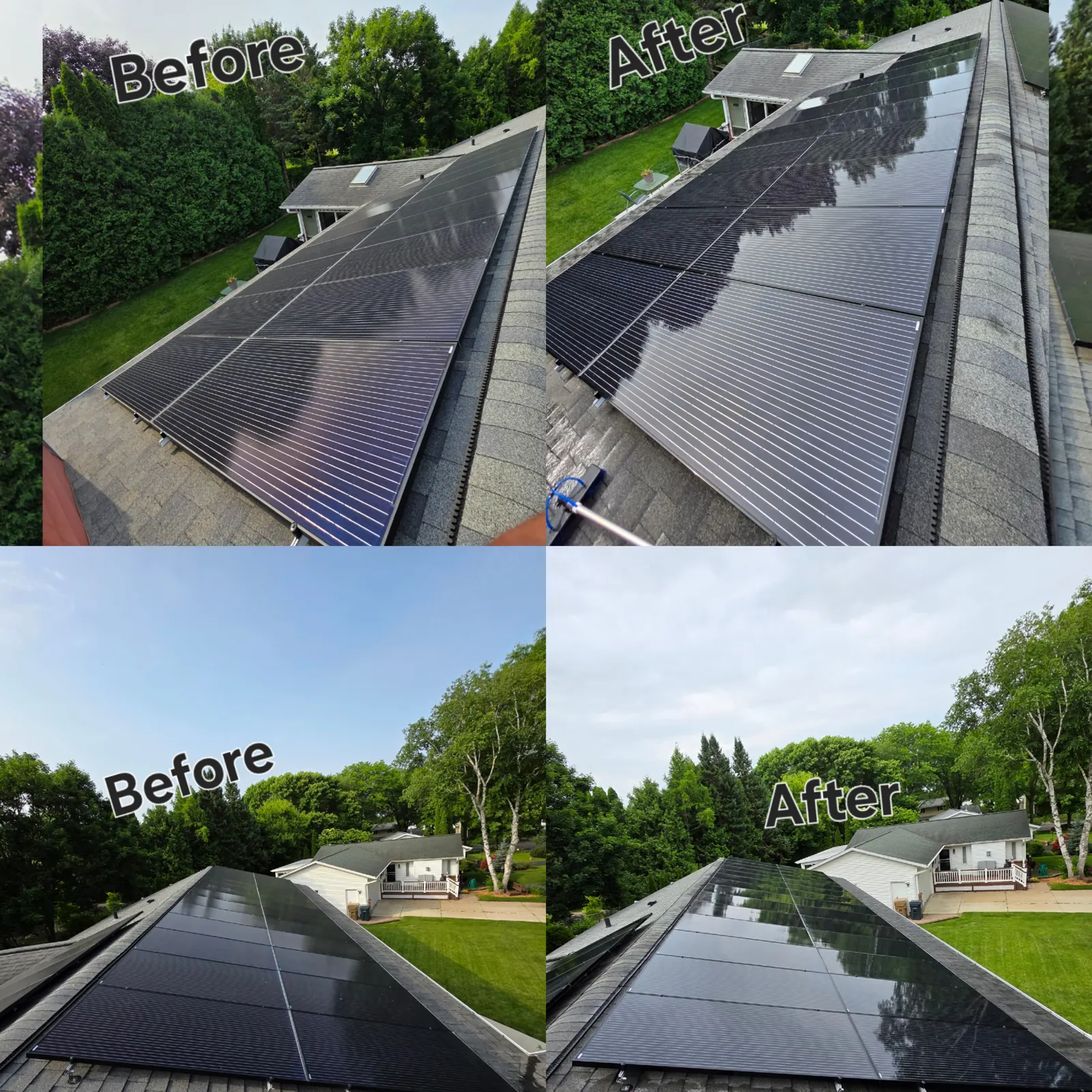
One measurement, stated plainly: Work I performed at the Wisconsin State Capitol measured 16.7% more sunlight reaching the glass after a single cleaning. That is a same-panel spot reading of light at the glass, not a system production claim. It is what a season of film can block at one spot on one roof.
The short version
Do not climb on a snowy roof. Do not pour hot water on cold glass. Do not pay anybody, me included, to rake snow off your panels. Do look at what fall left on the glass before the freeze — because that part does not melt off, does not slide off, and does not fix itself in spring.
If your array went through pollen season, harvest, and leaf fall without a cleaning, a fall visit is the last one on the calendar until spring. I am Solar Alchemist — Wisconsin's only company dedicated exclusively to solar panel cleaning — and I work 11 counties across southern Wisconsin, OSHA-trained and insured. My rates are on the pricing page. Text me a photo of your array at (608) 571-4173 and I will give you a straight answer, including "wait until spring" when that is the truth.